




“We just don’t know what happened to them,” ethnic studies teacher Guadalupe Carrasco Cardona said of students after a wave of ICE deportations swept Los Angeles.
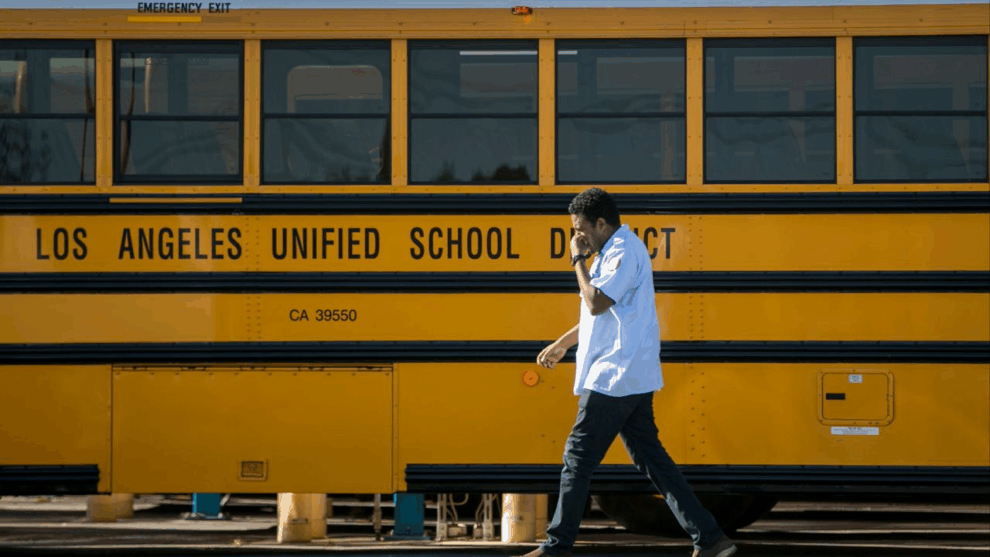
Over the last year, Los Angeles Unified School District (LAUSD) has been losing students at a pace officials still can’t fully explain. That said, it’s hard to ignore that a noticeable share of the declines happened in schools with large illegal immigrant populations—and even administrators now admit that ICE activity likely played a role.
“We’re not too sure if some students are sheltering in place, if they’re working, or if they got deported or self-deported,” ethnic studies teacher Guadalupe Carrasco Cardona told the Los Angeles Times. “We’ve done our best to help them with resources but with a lot of the kiddos, we just don’t know what happened to them.”
Cardona says her school is missing at least 200 students compared to what they projected. Districtwide, LAUSD came in roughly 7,000 students short of expectations this year. By conservative estimates, that’s a loss of $11.2 million based on LAUSD’s claim that it “gets about 90% of its funding from the state of California” and the remainder from the federal government.
Realistically, it could be even more.
Notably, that loss is on top of LAUSD officials doing everything they can to shield illegal immigrants from ICE—including offering to change students’ bus routes to circumvent ICE agents and having classrooms go into lockdown if immigration enforcement is detected in the area. That seems extremely intrusive and disruptive to the classroom experience for the vast majority of families that are here in the United States legally.
Naturally, this development is going to prompt emotional responses from both sides of the political aisle, as the Trump administration’s crackdowns on illegal immigrants remains a polarizing topic. But there’s another angle that almost no one talks about.
We’ve been told for decades that smaller class sizes are an educational good. If that’s the case, then shouldn’t fewer students in chronically overcrowded districts mean at least some improvement?
The research on class size almost invariably says yes. Tennessee’s famous Project STAR experiment found that smaller K–3 classes produced meaningful gains in reading and math. At one point, the U.S. Department of Education summarized the research by affirming that “students in small classes perform better in all academic subjects and on all assessments than their peers in regular-sized classes.”
A counterargument is that lower enrollment translates to a decrease in funding, which leaves the district under-resourced. It’s true that California’s school-finance system effectively pays districts based on how many students show up, as previously discussed. So when LAUSD loses thousands of students unexpectedly, the budget shrinks—and that usually means staff reductions.
Firstly, those funds primarily protect administrators’ salaries—not students. LAUSD Superintendent Alberto Carvalho alone makes a salary of $440,000 per year plus benefits. And in September, he just secured another four years of that arrangement. After his fifth year of employment, that will have cost taxpayers over $2.2 million—just to employ one person at a school district that’s hemorrhaging students.
Secondly, if a school district’s success is proportional to the state resources allocated to it, why do considerably leaner school districts across the country produce quantifiably better results than LAUSD with meager fractions of the funding?
In LAUSD, only 36.76% met or exceeded standards in mathematics while 46.45% met or exceeded standards in English Language Arts. That means roughly two-thirds of students are failing to meet the standard for math and more than half are failing to do the same in English.
And, even more concerningly, LAUSD officials touted this as a massive success because it’s the highest academic performance the district has ever achieved in the history of the assessment.
For reference, neighboring San Marino Unified School District—a much smaller and less-funded district—saw 84.74% of students meet or excel in math and 85.71% do the same in English. Same region; similar demographics. That’s a massive performance discrepancy.
And yet, California’s education funding has grown every year, even as enrollment—and performance, for that matter—has fallen across multiple decades. A few years ago, the state’s Legislative Analyst’s Office estimated that roughly forty cents of every tax dollar went to education. It hovers around that level now, depending on how you slice the budget. Nothing about this year’s enrollment decline—ICE raids or otherwise—is going to reverse that trend.
Districts don’t shrink despite lower enrollment; they fight to stay the same size. Buildings don’t close unless the situation is dire. Bureaucracies rarely contract on their own. So even with fewer students, the public doesn’t see meaningful savings.
Instead, they’ll likely see districts scrambling for emergency funding, “stabilization” grants, and new taxes to fill the gaps. LAUSD in particular plans to spend $18.8 billion next year, according to a spending plan submitted to the Los Angeles County Board of Education. That’s almost $3 billion more than the district takes in. How else will the district continue to spend money it doesn’t have?
“The focus that you continue to have, the only clear hard data that we ever see are the dollars that are budgeted—of which the largest expenditures of course are salaries and benefits. So the focus here is the dollars on their way out. But where in the bargaining agreements are student academic outcomes?” parent Maria Palma asked the LAUSD Board earlier this year..
California never spends less on education. California only spends more and more and more.
The even more uncomfortable point is that public schools in Los Angeles were already failing institutions that never fully recovered from the COVID closures they so eagerly embraced and probably never will. In March 2020, LAUSD was quick to close its doors to over 750,000 students citing health concerns. Over the next year and a half, LAUSD refused to reopen amid pressure from parent groups and pediatricians in the form of rallies, lawsuits, and pleas from Councilmember Joe Buscaino. At the time, then-Superintendent Austin Beutner called these efforts “political stunts.”
When LAUSD did finally reopen in Fall 2021—after many months of dismissing families’ concerns—they found their attendance had been utterly decimated: a dramatic fall from 750,000 to 408,083. A recent piece by Ben Chapman notes that nearly half of LAUSD’s 456 zoned elementary schools are now half-full or worse, and 56 have rosters that fell by 70% or more.
Now, the ICE-related enrollment drop accelerates a staggering decline that was already well underway.
If enrollment at LAUSD has fallen now by nearly half since 2020—and taxpayers fund the district based on enrollment—will taxpayers see savings on public education this year? Will Carvalho’s salary also see a 50% reduction?
No, of course not.
And while it’s not perhaps polite to say it, shrinking public school districts create openings for others to pick up the slack. Parents have options now in ways they didn’t 15 years ago. Homeschooling is exploding. Charter-school waitlists grow every year. Private-school enrollment is up, especially among lower-income families who are tired of instability. Many of these options are tuition-free. And, importantly, they’re outperforming California’s public schools across the board—especially with historically disadvantaged groups, like ethnic minorities, English learners, and students with disabilities.
That’s the real story here. ICE raids may have triggered the immediate enrollment shock, but the fragility of the system is what turned it into a crisis. A healthy district could absorb a few thousand disappearing students. LAUSD can’t—and hasn’t been able to for years—because it’s as far from healthy as heaven is wide.
“Now you continue to have decreasing enrollment due to dismal academic outcomes and poor fiscal management,” said Palma. “Your system that you created is rotting from within.”