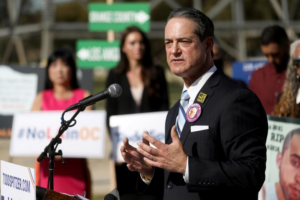







“There is no way to sugarcoat how poorly the town hall went for Orange County on Monday night,” reads a recent post by the Creek Team.
For months, residents in south Orange County have been raising alarms about the spraying of dangerous herbicides along San Juan and Trabuco Creeks—waterways that flow directly into Doheny State Beach, where local families swim, surf, and play. Through public records requests; social media organizing; and the discovery of chemicals such as glyphosate, triclopyr and imazapyr; community leaders began pressing county officials for answers about why and how this could happen.
Last week, Supervisor Katrina Foley—who represents the Fifth District containing southern Orange County and who had been facing overwhelming pressure to take action—held a town hall. It aimed to bring together concerned residents and a lineup of county agencies and officials to address the controversy.
It was nothing short of chaotic, according to attendees.
Voice of OC’s Editor-in-Chief Norberto Santana called Foley’s town hall a “bureaucratic circus.” Santana said Foley “tried to control the room as much as she could,” but that many in the crowd were “unable to sit through the bureaucrat’s bullshit” without reacting.
“This was a crowd too informed to be fooled,” said Santana. “And they asked good, hard questions.”
It’s easy to understand why the meeting got heated. Santana reports that the bureaucrats in question spoke for three hours and, throughout that entire time, “none of them answered questions in a straightforward manner.”
Beyond calling the meeting together and speaking for its first 30 minutes, what was Foley’s role? Some critics accuse Foley of riding the proverbial fence and trying to please all factions simultaneously—siding with residents when they made valid points and siding with county bureaucrats when expedient to do so.
Santana said that Foley frequently “scolded activists over their tone and hard push for accountability,” yet “even she got visibly frustrated at one point with the bureaucrats from the County of Orange for their inability to just answer questions in an open manner.”
“We are trying to give a full scope of how the county currently manages the system. And if you don’t care to know how the county currently manages the system, we can stop sharing how the county manages the system,” Foley said during one particularly pedantic moment.
It was immediately followed by loud groans and interruptions from the crowd. One attendee called back: “Just be concise!” to which Foley responded: “I agree. I think it would be better if it could be a little quicker. I agree with you.”
An interesting response, no doubt.
That sort of moment captures the broader criticism Foley now faces. She has long claimed to be an environmentalist and climate activist, but she hasn’t always delivered for residents who believe county agencies are stonewalling them and refusing to take action. Previously, Foley claimed she “[doesn’t] want chemicals more than anyone.” But she also made seemingly little effort to meet with concerned residents such as San Juan Capistrano resident Brent Linas.
The former Navy special operations officer became one of the key figures in this story when he started a community coalition known as the Creek Team last month. Linas operates the coalition’s Instagram account, which quickly amassed over 6,000 followers, to share resources and community complaints. It is now the leading voice against the county’s use of controversial herbicides in its channels and waterways.
Prior to the town hall meeting, Brent Linas told the Voice of OC that he had become frustrated with the “intransigence of county staff on the issue and his inability to meet directly with Foley.” In Foley’s defense, she attests this was not due to a lack of wanting to meet, but instead, being preoccupied with tending to her father who has since passed away. Last month, Foley’s office allegedly offered a 20-minute meeting, which Linas felt reflected a lack of concern.
“We felt it was a disingenuous offer only made after we went public,” said Linas. “They had their chance to work with us and they made it clear they didn’t want to.”
Were Linas and his coalition pleased with Foley’s town hall? It’s a bit of a mixed bag.
“There is no way to sugarcoat how poorly the town hall went for Orange County on Monday night,” reads a recent post by the Creek Team. It tags the official account for Orange County Public Works and continues “we won’t stop coming after you until you are held accountable for this horrible practice.”
“We will follow the money, the permit violations, [and] Endangered Species Act violations. This doesn’t end until you give up, our habitats are restored, and those that have been harmed have been helped,” the statement concludes.
But, separately, Linas expressed pleasure with the 200+ resident turnout and called Foley’s promise that the county would halt the spraying of herbicides a “huge victory for [the] Creek Team.”
That said, Linas told the Los Angeles Times it’s not over.
“We have to help the rest of the county end this practice,” he said. “The public overwhelmingly declared that they do not want this practice occurring in their backyard.”
Creek Team leader Bethany Nelms seemed a bit less optimistic. When—during the meeting—she pointed out that the county doesn’t test for herbicides at the mouth of San Juan Creek leading into Doheny State Beach, Public Health Officer Dr. Regina Chinsio-Kwong said that concerned residents could go to the Health Care Agency’s beach website to monitor beach water conditions. Santana wrote that this “[exposes] the county’s favorite way to look responsive,” which is “by pointing the public toward nonresponsive websites.”
“There’s no real protection,” Nelms later told Santana. “It’s all a facade.”
To her credit, Foley did eventually get in front of this issue. Holding a public town hall and announcing a halt to herbicide spraying was a tangible response to community pressure. But the chaos and unrest of the meeting also suggests a lesson for Foley or any elected official.
Perhaps residents with something to say should be heard early on. Not after months of can-kicking. Not after the issue balloons until it becomes the rallying cry of an entire community whose voices have grown too loud to continue being.