


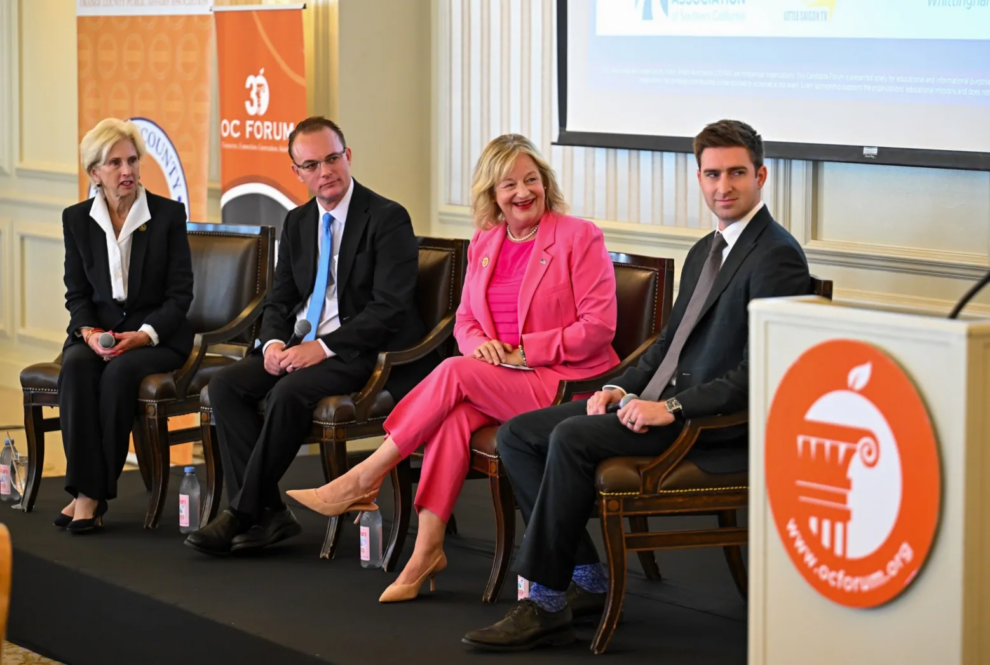

The roughly 90-minute forum covered county finances, public safety, homelessness, economic development and the county’s use of emerging technology.
Last Friday, OC Forum and the Orange County Public Affairs Association hosted a forum at the Pacific Club featuring the four candidates for the Orange County Board of Supervisors.
In District 5, incumbent Supervisor Katrina Foley (D) faces State Assemblywoman Diane Dixon (R). District 4 is an open race between Tim Shaw (R), president of the Orange County Board of Education and former La Habra mayor, and Buena Park Mayor Connor Traut (D).
The roughly 90-minute forum covered county finances, public safety, homelessness, economic development and the county’s use of emerging technology. The candidates often agreed on broad priorities but differed on how much government should spend, when private companies should provide public services and how the county should address homelessness.
Spending and economic development
The candidates largely agreed that Orange County should improve government efficiency without sacrificing services. All four expressed interest in using artificial intelligence to streamline administrative work, most notably permitting and emergency response.
While she did not mention explicitly whether AI made such improvement possible, Foley described how the county has already reduced processing times for environmental health permits from six to nine months to about 21 days. She also cited modernized employee reimbursement systems.
Dixon repeatedly emphasized controlling costs.
“The county does not have a revenue problem. The county has a spending problem… I do not want to see this county operate on deficits. We are committed to fiscal responsibility and we must live by that… We have to have a balanced budget with adequate reserves,” she said.
When asked about how the county can balance its expectation that it will provide high quality services while also being fiscally responsible, Shaw and Dixon spoke about the opportunity that comes with public-private partnerships (PPPs). Both cited examples from their own public service like La Habra’s conversion of a commercial office building into City Hall or Newport Beach’s Witte Hall project to illustrate how private donations helped deliver public facilities at a lower cost.
“It’s great to put out to RFP as much as possible. Let the private sector do what it does—compete—and you get a better return from the taxpayer’s perspective doing it that way” said Shaw. “I love the idea of competition and getting the best firm at the best price. That’s how we can maximize the return for the taxpayer.”
Traut, by contrast, warned against privatizing public services and criticized the current Board’s decision to stick with private provider Falck Mobile Health Corp.
Similarly, he called for clearer public accounting and greater scrutiny of money tied up in capital improvement projects that fail to advance. Foley too said that underused county-owned properties could generate revenue if the county put forward an economic development plan to put them to better use.
Specifically on the matter of the structural deficit and how the county might resolve its financial woes, Dixon called for lower operating costs and rejected the idea of borrowing from other accounts.
Shaw argued that the county government is hugely reliant on property taxes and should focus on making it easier to buy and sell homes—as when a home is sold it can be reassessed for a higher value via Prop 13.
Being the only sitting Supervisor among them, Foley was more keen to defend the county’s financial management. She pointed out that there is misleading information about the county tapping into its internal airport reserves to help fund an expansive, multi-year $700 million capital improvement program at John Wayne Airport. She said that not only had their reserves been replenished, but the county also added $12.8 million and it earned its first AAA credit rating since the bankruptcy.
“Orange County is leading in terms of job growth, [and] we’re leading in terms of increased wages—and this is obviously mostly in the private sector,” said Foley. “And so we must continue to support those businesses that are bringing jobs to our county and therefore bringing revenue to our county.”
Foley went on to talk about the importance of streamlining permitting, especially for housing developers. Later in the forum, Dixon took shots at Foley over numerous examples of development projects in the Fifth District stopping work altogether on projects due to lack of cooperation from her Office—most notably when Bob Olson of Dana Point Harbor Partners said a host of eleventh-hour demands by Foley “killed any hope of going forward” with plans to develop two luxury waterfront hotels in the marina.
“Some of these development projects—the Dana Point Marina project, the Laguna Niguel improvement project—[Foley] has been in office for six years and they’re still struggling with these kinds of issues,” said Dixon.
Public safety and surveillance
Taking a page from the playbook of District Attorney Todd Spitzer, who was in attendance, Shaw playfully tipped his hat to the “No L.A. in O.C.” campaign to affirm his support for the county’s tough-on-crime approach. Shaw also said the county does and should continue to invest in forest management to reduce wildfire risks. Traut later echoed similar sentiments, as this is a major priority to north county cities.
Traut also called for more investment in investigators and a victims-first approach, drawing on his experience as a mediator handling temporary restraining order requests.
Dixon criticized the State for failing to adequately fund Proposition 36 and said she would use her relationships in Sacramento to push for seeing some of those funds restored to Orange County. Foley responded by taking a jab.
“Well I wish you would do that now,” said Foley.
The two proceeded to spar about who has greater support from law enforcement groups.
The candidates also addressed automated license plate readers in unincorporated areas. All four supported their use while also acknowledging concerns about privacy or data handling. Dixon said she had been assured data would be discarded when it was not connected to an investigation. Foley said the county has used variations of this technology for 20 years—and it does so without partnering with Flock—and maintains restrictions on its use.
Traut briefly expressed particular concern about Flock’s alleged collaboration with federal immigration authorities, though Flock itself denies such claims.
Homelessness and behavioral health
The candidates largely agreed that homelessness requires action but offered different approaches to measuring results and enforcing public-space rules.
Traut called for more shelters in southern Orange County, motel conversions and greater investment in preventing homelessness from the onset. He also said the county should invest more in treatment programs and helping those who are “close to homelessness.” And interestingly, he added—at risk of breaking rank with many fellow Democrats with whom this opinion is less popular—that he supports law enforcement keeping the homeless out of public parks and open spaces.
“The part that’s a bit more maybe controversial—but I stand by it—is we need to clean up our parks and open spaces. We need enforcement… Our children, or families deserve clean and health open spaces,” said Traut.
Shaw called for compassion paired with accountability, citing the Anaheim Riverbed encampment—which reached a peak of around 1,000 homeless individuals mere miles from Disneyland Resort in 2017-2018—as an example of what can happen when homelessness goes unaddressed. Dixon advocated revisiting PPs and called for more state funding.
Foley focused on oversight of the organizations delivering services. She said the first audit authorized by her office found that nonprofit contracts lacked adequate performance metrics. The county subsequently revised its contracts to better track outcomes such as employment placements and treatment. Foley said she was also pursuing an internal audit to identify funds sitting in overlooked accounts.
Leadership and the county’s next CEO
The candidates found broad agreement on the qualities needed in the county’s next chief executive, who oversees more than 18,000 employees. Dixon emphasized budget oversight and accountability to the Board of Supervisors. Foley called for ethical leadership, transparency and strong relationships with board members. Shaw cited public administration training and experience managing large organizations.
Traut said it must be a leader with integrity and crisis-management experience.
“We must not politicize the CEO office,” said Traut. “I will oppose that if it tries to make its way with the county. The second thing is [that] the county CEO should not be seen as the sixth Supervisor.”
The forum closed with questions about artificial intelligence and a proposed increase in hospital fees. The candidates generally supported using AI in government while maintaining human oversight and security safeguards. On hospital fees, Foley opposed shifting costs to hospitals amid state and federal funding cuts. Dixon called for an audit before making a final decision but opposed a steep increase, while Shaw also expressed opposition. Traut argued that fees should recover costs, not be seen as another form of revenue generation—which is another policy that may put him at odds with others on the Left.
The general election will be held on November 3rd, but ballots are already being mailed to voters across the county. In-person voting at designated vote centers will begin on October 24.