





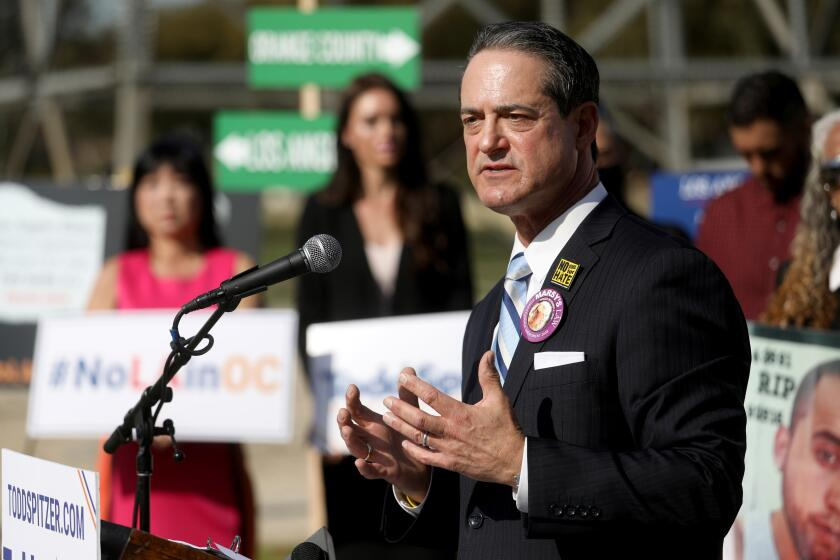

“None of the allegations alleged in these three lawsuits were proven in a court of law,” said OCDA spokesperson Kimberly Edds.
Calling Orange County District Attorney Todd Spitzer “Orange County’s most expensive politician” is catchy. But it’s also doing a lot more work than the underlying facts can reasonably support.
That’s the framing used in recent coverage by the Voice of OC on a string of settlements involving former prosecutors and investigators alleging retaliation or misconduct inside the DA’s office. Most of the lawsuits against the county center not around Spitzer himself, but Gary LoGalbo—a former Senior Assistant District Attorney who resigned around six years ago following allegations of sexual harassment. Logalbo has been dead for three and a half years.
Coverage across numerous outlets often goes out of its way to highlight that LoGalbo was the best man at Spitzer’s wedding nearly 30 years ago. There seems to be an implicit insinuation here that their preexisting personal friendship somehow translates to Spitzer’s knowledge of, or complicity in, workplace misconduct years later. There has been no evidence presented that Spitzer was aware of LoGalbo’s alleged behavior at the time it was occurring, much less that he endorsed it.
“I have been unequivocally clear that I never personally witnessed the alleged behavior or anything similar during my interactions with this former employee or was I ever told of any such behavior,” read a statement from Spitzer back in 2021. “Had I been aware of these allegations at any time, I would have taken swift and decisive action.
If anything, Spitzer has—in the words of spokesperson Kimberly Edds—“been nothing but supportive of these victims and any allegation to the contrary is false.”
“As soon as allegations of misconduct and inappropriate behavior came to our attention, we initiated an immediate investigation with OCDA HR. This fact is indisputable and is confirmed by the report,” stated a release by the DA’s office.
Indeed, an independent investigation was concluded which found that “the OCDA responded promptly, appropriately, and no employee was subjected to retaliation.”
That didn’t stop multiple parties from coming forward to allege that retaliation had occurred. Most of these cases have since been settled. But a settlement in these cases is not a finding of guilt. The county made a financial decision to resolve them rather than litigate, which is not uncommon in politically sensitive employment disputes or where litigation risk is unpredictable and costly.
Out of at least ten cases that have been brought forward, only one ever determined culpability on Spitzer’s part. In the case of Tracy Miller, a jury concluded that Spitzer had retaliated against her, and she was awarded roughly $3 million, plus attorneys’ fees. But even here, context matters.
Spitzer has argued the dispute was over dissatisfaction with Miller’s work performance on high-profile public corruption cases, not retaliation for whistleblowing: “It is no secret that there was a lot of frustration on my part with her lack of performance in handling these very serious matters. In hindsight, I realize that I was not as sensitive to the issues Ms. Miller was facing at the time as I should have been, and for that I am truly sorry.”
The Voice of OC piece acknowledges that the six other women who received a combined $5.1 million in settlements did so without judicial determination that Spitzer retaliated against any of them. And yet they lump those settlements together with the Miller verdict as part of “Spitzer’s tab with the taxpayers” when they do not constitute equally proven claims against him.
“We are not in any way surprised by these settlements or the dollar amount since County Counsel broke its promises to these women and betrayed their trust,” said Edds.
Their reporting does acknowledge the Bethel Cope-Vega case in which a county prosecutor initially alleged retaliation by Spitzer, then dropped those claims. Spitzer later appeared as a witness in her defense. Her $3.5 million judgment was tied to harassment by LoGalbo and the county’s failure to prevent it—not to any misconduct by Spitzer.
Once cannot cite her payout as evidence against Spitzer when her claims against him were withdrawn. Nor can they count the case of Jennifer Kearns, who received $2.75 million after alleging Spitzer interfered with the prosecution of a Newport Beach doctor. Again, this was a settlement: there was no court ruling that Spitzer “tanked” the case. In fact, Spitzer’s office has consistently argued the underlying sex charges were not provable beyond a reasonable doubt and were improperly pursued by his predecessor.
Disagreements over whether a case should be brought or how it should be handled are not, by themselves, evidence of misconduct. Turning that into a payout does not establish that Spitzer acted corruptly; it establishes that the county chose not to litigate the dispute to conclusion.
As an evergreen reminder, Spitzer leads the sixth-largest prosecutor’s office in the United States with a staff of over 900 employees, including high-profile attorneys and investigators across a department filing more than 70,000 cases annually. In an operation that size, which faces immeasurable scrutiny for its handling of tough cases, internal personnel disputes, and constant legal exposure, settlements are a cost of doing business. If every payout approved by the Board of Supervisors is going to be pinned on the elected DA, then almost anyone in that seat would carry the same label by default.
And when you strip away the aggregation and look at the actual record, the fact remains that only one case resulted in a jury finding against him. Spitzer acknowledged it and apologized publicly. Meanwhile, Spitzer remains broadly popular with Orange County voters, in large part because his tough-on-crime approach has made the county a regional outlier on public safety compared to Los Angeles County to the north and San Diego County to the south.
That may not fit neatly into a tidy and convenient headline, but it’s a more complete picture than the one being sold.