



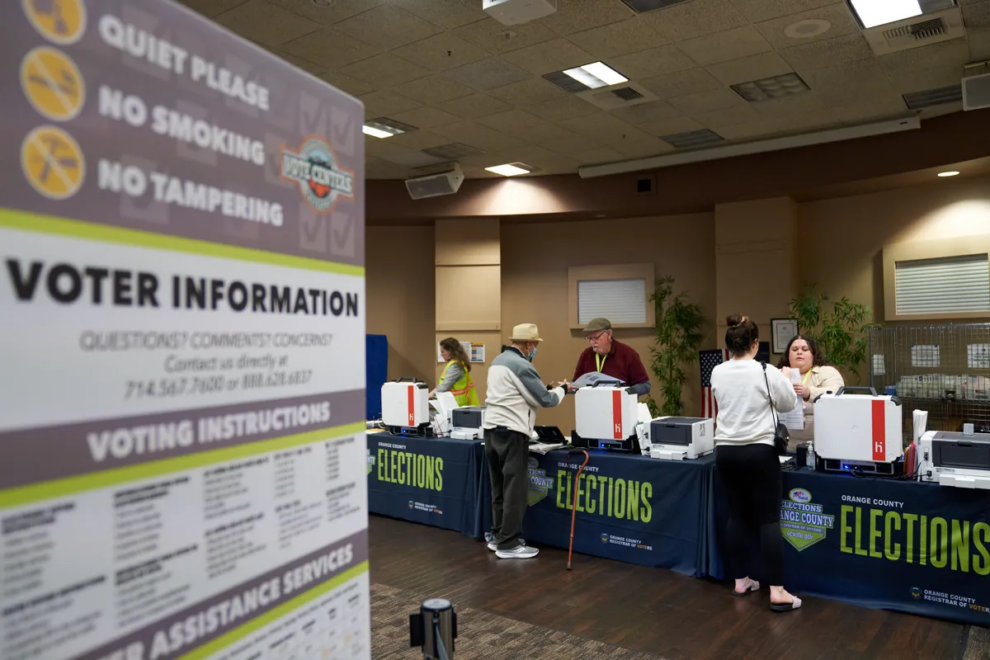

“Government should be made up of the community you live in—not Sacramento telling Huntington Beach how to run their city or how to vote in their city council,” Huntington Beach resident Cindy Guinasso told the California Post.
In a shocking turn of events, an Orange County Superior Court judge has tentatively ordered Huntington Beach to replace its at-large City Council elections with ranked-choice voting. In so doing, Judge Craig Griffin handed over a huge win to controversial Democrat lawyer, Kevin Shenkman, who has made a prolific career of suing California cities with the aim of seeing them forced to adopt new voting systems.
The decision is an unexpected development in a battle that began nearly a decade ago.
In 2017, Shenkman—on behalf of the Southwest Voter Registration Education Project—sent Huntington Beach a demand letter accusing the city of unlawfully diluting Latino voting strength. Cities across California have received similar letters from Shenkman over the past two decades. Many opted to settle and switch to district elections rather than spend millions defending themselves in court.
Huntington Beach chose the opposite path, as it often does.
City officials argued that the California Voting Rights Act could not displace the city’s constitutional authority over municipal elections. They maintained that every resident benefits from electing every councilmember and rejected claims that the system denied Latino voters meaningful representation, with City Attorney Michael Gates responding to Shenkman’s letter: “you are clearly unfamiliar with the demographic and historical voting in Huntington Beach you clearly do not have the best interests of our Latino community in mind.”
And, for what it’s worth, Huntington Beach has elected Latinos on numerous occasions from current City Councilwoman Gracey Van Der Mark to former Councilmen Tito Ortiz and Devin Dwyer. In fact, Ortiz was at the time the City’s all-time highest vote-getter at 42,246, crushing Dan Kalmick in second place by around 12,000 votes.
Nevertheless, in 2024, Huntington Beach resident Victor Valladares filed a lawsuit—with Shenkman as his lawyer—alleging that the City somehow disenfranchises Latino voters.
“I guess I’m not the ‘right kind’ of Latina,” said Van Der Mark in response to the news. “This is ridiculous.”
In siding with the plaintiffs last weekend, Griffin opted against ordering district elections—the remedy used in most California Voting Rights Act cases—in favor of the much more experimental ranked-choice voting, a system whereby voters rank candidates in order of preference, with the lowest-performing candidates eliminated and their votes redistributed until one candidate earns a majority.
How widespread is this practice? Currently, there are six states with laws authorizing or requiring the use of ranked-choice voting, including California, Hawaii, and Colorado. Conversely, more than three times as many states have laws prohibiting it, including Florida, Kentucky, and Indiana.
Even in California, there are only a handful of cities using it, and all of them are deep-blue bastions—cities like San Francisco, Oakland, Berkeley.
Reactions from the community have been overwhelmingly negative. Many feel this was an obvious power play by one party to subvert a municipal government—and, by extension, the will of its residents—which has long been a thorn in Sacramento’s side.
“They’ve been coming after Huntington Beach for years because we do not follow his rules,” Huntington Beach resident Cindy Guinasso told the California Post. “Government should be made up of the community you live in—not Sacramento telling Huntington Beach how to run their city or how to vote in their city council.”
State Assemblyman Tri Ta issued a statement asserting that the ruling “undermines local control over municipal elections” and that “Californians deserve election laws that respect both the Constitution and the choices made my local voters.”
Judge Griffin also unilaterally ordered that the City’s use of staggered terms—extremely common in at-large elections—be eliminated so that all City Councilmembers will be up for election at the same time. This would force Councilmen Don Kennedy, Butch Twining, and Chad Williams—all of whom were elected to serve a four-year term—to surrender two of those years and run for reelection now.
“Some charter eggs will be broken in the making of this omelet,” Griffin acknowledged almost dismissively.
Cute food analogies aside, actual Huntington Beach residents are fuming—and many are confident that the ruling could be overturned.
“This is ridiculous,” said former State Assemblyman Matt Harper. “This judge is trying to fabricate new case law knowing full well that no one can draw a CVAP majority non-white Hispanic council district in Huntington Beach and that racially or ethnically drawn district maps would be overturned in court. It is important to note that for the plaintiffs, this is a loss, [as] they did not get districts. With a skilled legal team the City should be able to get this mess overturned on appeal.”
City Attorney Mike Vigliotta said Huntington Beach is reviewing the ruling with outside counsel.
Orange County Registrar of Voters Bob Page said that Huntington Beach has the authority under state law to conduct its own elections, and if the city were to ask for aid in facilitating ranked-choice voting, the Registrar “does not currently have a viable way to conduct a ranked choice voting election for the City.”
In theory, ranked-choice voting could go into effect prior to the November general elections. That is—if Huntington Beach doesn’t defy the order outright. And, judging by comments from social media users online, there is no shortage of enthusiasm urging officials to do just that.
“Refuse it. Let the activist judiciary sue you. Take this voting rights matter to SCOTUS,” commented one Instagram user.
“Keep fighting it,” commented another. “Don’t give in.”
“Hold strong HB!” said yet another.