




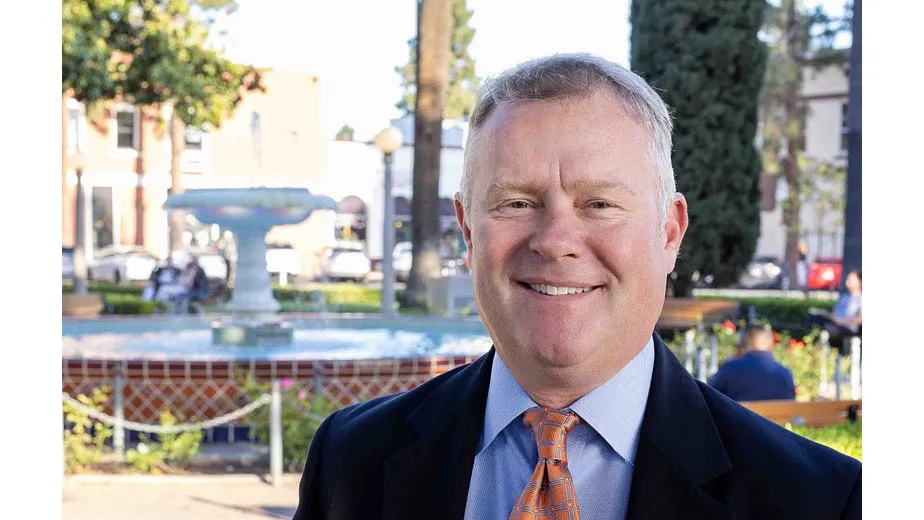

“I’m running because I watched this city cut crossing guards days before school started and then scramble to bring them back, and I recognized the pattern: act first, think second,” said District 1 candidate Jonathan St. Clair.
This November, a new leader will join Orange’s City Council.
That’s because, however the chips may fall, District 1 will ultimately go to one of four newcomers. Its current representative, Councilwoman Arianna Barrios is now running for Mayor against existing Mayor Dan Slater. Regardless of how that race plays out, Barrios leaves an open seat which in due time will either go to Ernest Glasgow, Jonathan St. Clair, Albert “AJ” Ricci, or Brandy Romero.
With that many challengers in the running, we thought it best to ask each of the District 1 candidates a list of questions and run a profile on each. At the time of writing, only Ricci and St. Clair have submitted their responses. We will publish profiles on Glasgow and Romero if and when they respond.
What follows is our profile on Jonathan St. Clair. For our profile on AJ Ricci, please click here.
By his own admission, St. Clair is “not a career politician,” but a parent and taxpayer whose family calls Orange home. He is the General Manager and Co-Founder of the Jasper Ray Foundation—a non-profit which raises awareness and prevention to drowning and child safety—and his wife is a small business owner.
“I’ve spent years running a nonprofit focused on drowning prevention—work built on a single idea: that preventable tragedies happen when everyone assumes someone else is handling it. That’s the instinct I’d bring to city hall: ask the hard question early, while it’s still cheap to answer,” said St. Clair. “I’m running because I watched this city cut crossing guards days before school started and then scramble to bring them back, and I recognized the pattern: act first, think second.”
St. Clair was not shy about stating his belief that the past leadership on the Orange City Council has moved the city in the wrong direction. In fact, he can point to a single meeting which he believes best illustrates why: June 3, 2026.
This was the date the City Council placed Measure I, a 13-year sales tax, on the ballot at a special meeting “that ran under twenty minutes, with almost no public discussion.” To say the move was controversial would be an understatement.
“Whatever you think of the tax itself, that is not how a city asks its residents for money,” said St. Clair. “Voters had already turned down a smaller sales tax in 2024. That should have prompted a serious public conversation about why, not a quick vote timed to the quietest week on the calendar.”
He reiterated that his concern isn’t the measures themselves, but rather the process. As with cutting the crossing guard program, St. Clair believes Measure I points to a repeating pattern whereby “decisions [are] made fast, explained late, and absorbed by families and small businesses who got no warning.”
Though that may sound charitable to the measure, he did make it clear that he believes the City is ignoring its obligation by asking taxpayers to carry the burden for low revenue. A better strategy, he argues, would be to enact policies that raise revenue and increase the tax base without having to ask residents to fill the gap.
“The hotel tax makes the point better than I can. Orange sits minutes from the Anaheim resort district, we host a university where families and visitors need somewhere to stay, and we have a downtown people genuinely want to spend a weekend in yet we don’t have close to the hotel capacity that should come with all that. Before raising the rate on the rooms we have, and possibly discouraging the hotel operators we want, why hasn’t the city worked to encourage more hotel development, including higher-end hotels, and collected the taxes already on the books?” asked St. Clair. “That’s revenue we’re leaving on the table.”
It’s no surprise, then, that St. Clair believes Orange’s biggest challenge over the next few years is its finances. As mentioned in our profile on AJ Ricci, the City faces a structural shortfall projected to total $122 million in cumulative deficits over the next six years. City staff readily admit—often alongside calls of support for Measure I—that not solving the matter “would increasingly affect the services residents see, use, and rely on every day, including police protection and 9-1-1 emergency response; fire protection and paramedic services; street, sidewalk, and infrastructure maintenance; and parks and other community services.”
In other words, “the city is facing a serious structural shortfall, and everything residents actually care about runs through it,” said St. Clair.
“That gap didn’t appear overnight and it won’t close with a single vote in November. It’s the product of a decade in which the city let its tax base stagnate while costs climbed,” he continued. “The fix is unglamorous and long overdue. Make Orange a place businesses actually want to open, where permits don’t take months—or even longer—and where spending happens in public view.”
St. Clair is not endorsed by any sitting Councilmembers, something he believes is a boon: “I’m not endorsed by any sitting council member, so I’m not carrying anyone’s ideology or anyone’s pet project… I came to this race without a political sponsor and without debts to pay off in office.”
To conclude, we asked if there’s anything else he’d like residents of Orange to know.
“I’m running because the gap between what Orange could be and what it currently is has gotten too wide to ignore,” said St. Clair. “Because most of what’s wrong here is fixable by people willing to do boring work in public. Faster permits and less red tape. Budget documents posted before the meeting, not after. Parks and safe routes to school treated as basic obligations, not line items to cut when the year goes sideways.”
He continued: “My kids attend an Orange Unified School District dual immersion school which is a choice we made because we wanted them growing up alongside the whole community, not a slice of it, and because that classroom is a pretty good picture of who Orange actually is… Orange has real advantages—location, history, a downtown other cities envy. Its leadership has been resting on its laurels. It is time to do the hard work to make Orange the place its residents deserve.”